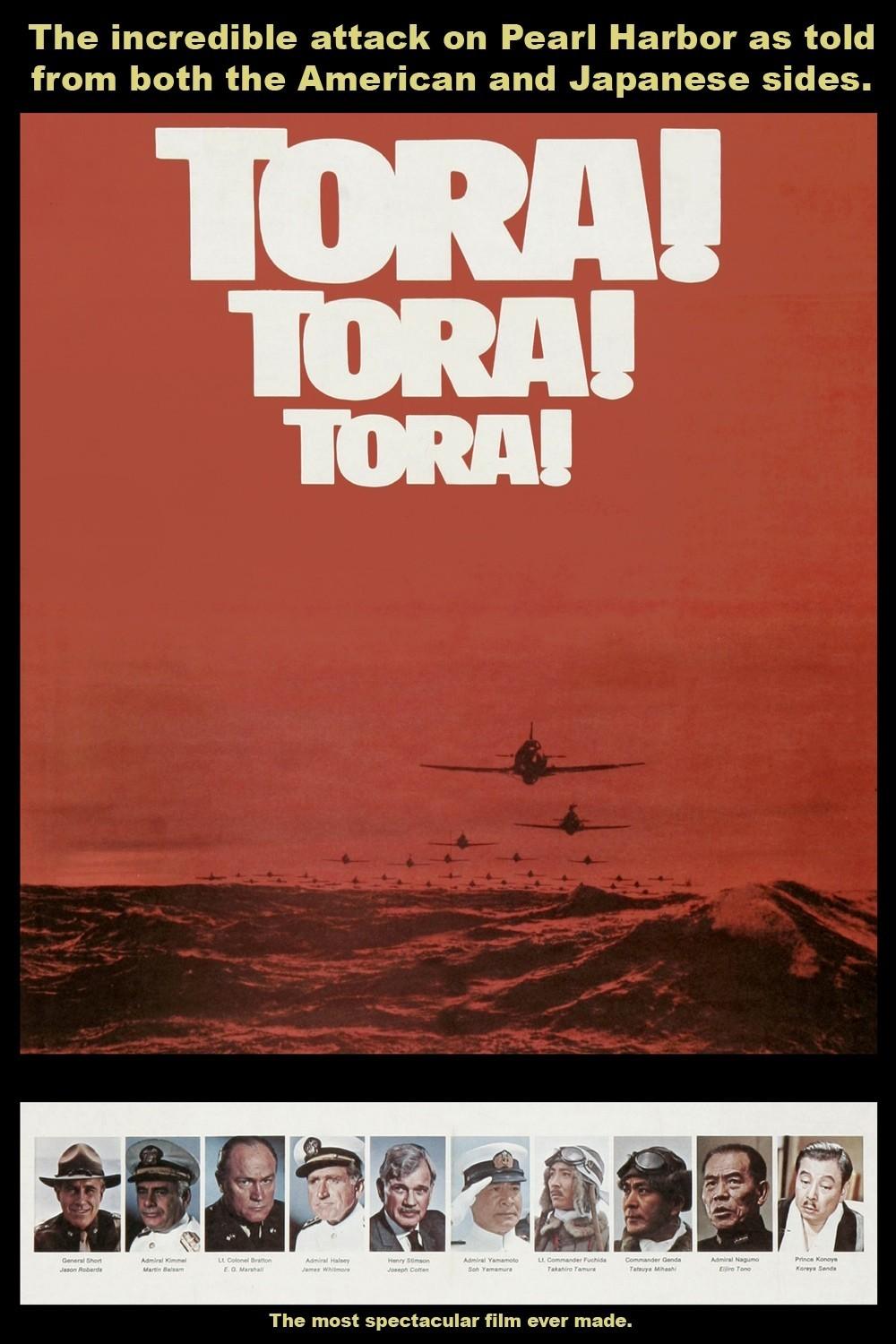
Tora! Tora! Tora!

20th Century Fox
Release Date: Sep 23, 1970

The story of the 1941 Japanese air raid on Pearl Harbor, and the series of preceding American blunders that aggravated its effectiveness.

Watch onappletv+
Tora! Tora! Tora!

Current Showtimes

orround
  • Fri Aug 21
  • Sat Aug 22
  • Sun Aug 23
  • Mon Aug 24
  • Tue Aug 25
  • Wed Aug 26
  • Thu Aug 27

    Technical Specifications

    Aspect Ratio: 2.35 : 1

    Other Details

    Country of Origin: Japan,United States

    Language: English,Japanese
    Summaries

    Plot Summary

    • Tokyo, 1941: As World War II rages in Europe, Japan sees a significant military shift. Following a trade embargo imposed on a belligerent Japan by the United States a year prior, severely limiting raw materials, including oil due to the war Japan has been waging in China since 1937.Influential Japanese army figures and politicians push through an alliance with Germany and Italy, despite opposition from the Japanese navy, and prepare for war.Admiral Isoroku Yamamoto (So Yamamura) takes command as the Commander-in-Chief of the Combined Fleet during a ceremony aboard the battleship Nagato, the flagship of Admiral Yamamoto. He assumes the position from the departing Fleet Admiral Zengo Yoshida (Junya Usami). A meeting between Prime Minister Fumimaro Konoye, Foreign Minister Yosuke Matsuoka, and the hot-headed War Minister General Hideki Tojo (Asao Uchida) reaches a consensus that the time is now ripe to attack the US. Matsuoka believes the U.S. to be Pre-occupied with the war in Europe and when Konoye warns that the US has an army in the Philippines and has moved its Pacific Fleet to Pearl Harbor in Hawaii, Matsuoka argues that it is all the more reason to prepare for war.The fear of war in Admiral Yamamoto increases when Militarist Japan signs the Tripartite Pact with Nazi Germany and Fascist Italy in Berlin, making Japan the third member of the Axis Powers. Saburo Kurusu, at the time Japan's ambassador to Germany, is the direct signatory of the pact.In Yoshida's cabin, the two discuss the severe impact of America's trade embargo, which deprives Japan of essential raw materials, including oil. Despite both recognizing that a war with the United States would be catastrophic, aggressive Army factions and militarist politicians drive Japan into an alliance with Germany and initiate war plans, believing the U.S. is too occupied with Europe. Viewing the U.S. Pacific fleet at Pearl Harbor as a dire threat, Yamamoto begins planning an unprovoked strike, convinced that Japan's only chance lies in destroying the American Pacific fleet at the onset of conflict. Yamamoto warns that even if that was achieved at the start, he warns Japan would have the advantage for perhaps six months Air Staff Officer Minoru Genda is chosen to mastermind the operation, while his old Naval Academy classmate Mitsuo Fuchida is selected to lead the attack.During the planning of the attack, Japanese commanders discuss the vulnerability of Pearl Harbor to a torpedo strike. They note that torpedoes dropped from aircraft typically descend and submerge at least 75 feet (23 meters) below the surface. Given that Pearl Harbor is only 40 feet (12 meters) deep, the Americans believe they are naturally defended against torpedo attacks. However, the Japanese devise a strategy to overcome this challenge. They fit small wooden stabilizers to aerial torpedoes, making them effective in the shallow harbor. They also retrofit armor-piercing battleship shells, converting them to aerial bombs effective against the American ships.This belief is reflected in conversation while overflying the harbor between Admiral Husband Kimmel, the new Commander of the Pacific Fleet, and his predecessor Admiral James Richardson, bitter because he had opposed moving the Fleet from San Diego.In a significant intelligence breakthrough, American operatives in Washington successfully decode the Japanese Purple Code, enabling the United States to intercept what the Japanese believe to be secure radio communications. U.S. Army Col. Bratton and U.S. Navy Lt. Commander Kramer monitor the transmissions. As American intelligence in Washington gathers increasingly alarming radio intercepts, they relay their concerns to the White House staff, who appear surprisingly unresponsive. The American reaction seems notably lax.Japanese commanders enlist the renowned Air Staff Officer Genda Minoru (Tatsuya Mihashi) to orchestrate the attack.At Pearl Harbor, Admiral Kimmel (Martin Balsam) Commander-in-Chief, U.S. Pacific Fleet, and General Short (Jason Robards) Commander-in-Chief, U.S. Army Forces Hawaii, work diligently to strengthen defenses. General Short orders the aircraft to be clustered in the center of the airfields to prevent sabotage, so General Howard Davidson (Edward Sheehan) of the 14th Pursuit Wing tries dispersing some planes to other airfields on Oahu to maintain air readiness. General Short also arranges more radar stations, a very new air defense technology for that time for that old soldier and overcomes conflicting administrations like the Parks department to make that possible.In Japan, Yamamoto attempts to avert the attack, criticizing the Japanese Army for aggressively pushing for war when peace remains a viable option. Yamamoto emphasizes the formidable strength of the United States, asserting that to defeat it, merely destroying the U.S. fleet or even capturing Hawaii would be insufficient. He believes Japan would need to invade the mainland, a feat Yamamoto views as impossible.Months pass while diplomatic tensions escalate. As the Japanese ambassador to Washington continues negotiations to stall for time, the Japanese fleet forays into the Pacific. The Japanese ambassador to the U.S. is seen requesting additional information from Tokyo to support negotiations aimed at preventing war. However, General Tojo (Asao Uchida), Japan's Minister of War, is portrayed as staunchly against peace.During this time, the Japanese initiate a sequence of 14 radio transmissions from Tokyo to their embassy in Washington, culminating in a declaration of war. The Americans, however, are decoding these messages faster than the Japanese embassy, giving them advance knowledge of the impending attack before the Japanese ambassador can deliver the formal notice.On the morning of Sunday, December 6, 1941, American intelligence officers work feverishly to interpret coded transmissions. They learn that the final message will be received precisely at 1:00 PM Washington time the following day. On the morning of December 7th, Lt. Col. Rufus S. Bratton (E.G. Marshall) Chief, Far Eastern Section, Military Intelligence Division, War Department, one of the officers decoding the messages, notes that the final instruction directs the Japanese Ambassador to destroy their code machines after decoding the last of the 14 messages, a foreboding detail.Deducing the Japanese will launch a surprise attack after the messages are delivered, Bratton's frantic attempts to convey this critical information to American commanders are thwarted as they are occupied with a Sunday round of golf. Eventually, Bratton informs Chief of Naval Operations Harold Rainsford Stark (Edward Andrews) of the heightened threat. Stark, however, chooses to wait to inform Hawaii until after consulting the President.Finally, at 11:30 a.m. Washington time, Colonel Bratton convinces the Army Chief of Staff, General George Marshall (Keith Andes), of a significant threat, prompting Marshall to order that Pearl Harbor and all other Pacific installations be notified of an impending attack. George Marshall's order that Pearl Harbor be alerted of an attack is stymied by poor atmospherics that prevents radio transmission, and by bungling when a warning sent by telegram is not marked urgent. Marshall's communication will arrive in Pearl Harbor after the attack has begun.Meanwhile in Hawaii, the American destroyer USS Ward spots a Japanese two-man midget submarine attempting to penetrate the defensive net and enter Pearl Harbor. The destroyer attacks and sinks the submarine, promptly notifying the base. Although Lieutenant Kaminsky (Neville Brand), the receiving officer, takes the report of an attempted enemy incursion seriously, Captain John Earle (Richard Anderson) at Pearl Harbor demands confirmation before calling an alert.Admiral Kimmel later learns of this negligence and is furious he was not told of this enemy action immediately. Rather then call a high alert, he decides to call for an emergency meeting of his officers at headquarters at 8:00 am.Shortly after 7:00 a.m., two U.S. Army privates, Joseph Lockard and George Elliot, stationed at a remote radar post, detect the incoming Japanese aircraft and inform the Hickam Field Information Center. However, the Army Air Forces Lieutenant in charge, Kermit Tyler (Jerry Cox), dismisses the report, assuming it is a group of American B-17 bombers arriving from the mainland.The Japanese plan to break off negotiations at 1:00 pm Washington time, 30 minutes before their attack. However, the Japanese ambassador's typist is slow and cannot decode the 14th part of the message in time. Consequently, Ambassador Kichisaburo Nomura (Shogo Shimada) decides to postpone his meeting with the Secretary of State.The incoming Japanese fighter pilots are pleasantly surprised to find no anti-aircraft fire as they approach the base. Commander Mitsuo Fuchida (Takahiro Tamura), the squadron attack leader, radios the code phrase "Tora, Tora, Tora," indicating complete surprise has been achieved.Once the attack is underway, America's response and return fire against the Japanese planes is frantic but only partially effective. Upon spotting the Japanese low-level bombers, an American officer instructs his colleague to get the tail numbers, thinking they are American planes violating safety protocols. This misconception is quickly dispelled when the planes deliberately drop bombs on the base.The aircraft security measures turn out to be a disastrous mistake, allowing the Japanese aerial forces to easily destroy the U.S. aircraft on the ground, thereby crippling an effective aerial counterattack. All the aircraft on the runways at the major airfields are spectacularly destroyed, either during takeoff or while still parked.Amid the mayhem the force of B-17 bombers Lt. Tyler mistakenly believed was the earlier radar contact, a force commanded by Major Truman Landon, arrives at Oahu per schedule and is immediately attacked by both Japanese fighters and gunners from US ships mistaking them for enemy craft, forcing the bombers to scatter and try to make emergency landings. As if this crisis wasn't enough for Major Landon's unarmed and low-on-fuel bomber squadron, the Major's own plane's landing gear cannot deploy completely and he has to crash land at an airbase, although apparently with no injuries.There are still acts of American heroism such as Doris Miller, an African-American seaman who goes above and beyond the call of duty (especially considering he was not allowed to be trained in an on-board combat role due to the US Navy's policies) to take command of an unattended machine gun to help defend the base. Two American fighter pilots, Ken Taylor (Carl Reindel) and George Welch (Rick Cooper), race to the remote Haleiwa airfield, which remains untouched by the Japanese attack, and manage to take off to engage the enemy. Taylor and Welch successfully engage several Japanese planes over Oahu, shooting down multiple fighters and bombers while escaping unscathed.The catastrophic damage to the base is vividly detailed, with sailors fighting as long as possible before abandoning sinking ships and jumping into the water, which is covered with burning oil. The sight of the wreckage also enables Lieutenant Kaminsky to deliver comeuppance to the horrified Captain Earle when he arrives at the base and sees for himself the havoc wrought by the Japanese.The pivotal point of the attack comes amid a plethora of torpedo hits delivered to several US battleships - a Japanese bomber, sporting one of the converted armor-piercing shells, closes on its target - identified via a newspaper photo taped to the cockpit's side - the USS Arizona. The bomb lands on the ship's armored deck near one of the main turrets, smashes through, detonates forward magazines, and the maelstrom of explosions erupts into one catastrophic blast whose shock-wave rocks even the bomber. In addition to that loss, the sinking of the battleship sinks on the underwater pipes below that supply water for firefighters, impeding their effort to prevent fires from reaching the base's massive oil storage facilities and potentially causing catastrophic new fires and explosions that could destroy much of the entire base.At the end of the attacks, Fuchida and the surviving Japanese planes return to their carriers and urge a third wave against Pearl Harbor, suggesting a late afternoon or evening strike. However, Admiral Chuichi Nagumo (Eijiro Tono), the Japanese fleet commander, refuses to launch the third wave, fearing the increased risk of detection and destruction of his six carriers by the still-absent US carriers. The US Carriers had departed days previously to search for Japanese vessels in the Pacific This decision has been debated over the years, as a third wave might have inflicted significant damage by targeting large oil tanks, dry docks, and repair facilities, potentially crippling the U.S. Pacific Fleet for months. Despite strong protests from Fuchida and most naval officers on the carrier flagship Akagi, including Genda, Nagumo overrules them and orders the Japanese fleet to sail for home.At the conclusion of the attacks, with the U.S. base engulfed in flames, its frustrated commanders, Short and Kimmel, finally receive the Pentagon's telegram warning them of impending danger. In Washington, U.S. Secretary of State Cordell Hull (George Macready) is stunned upon learning of the audacious assault and urgently seeks confirmation before meeting the Japanese ambassador waiting outside his office. The distraught Japanese ambassador, unable to justify the delayed ultimatum and the unprovoked surprise attack, is bluntly rebuffed by Hull, who coldly responds to the final Japanese communique: "In all my fifty years of public service, I have never seen a document so crowded with falsehoods and deliberate distortions on such a scale that, until this day, I would have thought no nation on earth capable of uttering them!"Back in Japan, Admiral Yamamoto laments that the Americans did not receive the declaration of war until 50 minutes after the attack began, noting that nothing would enrage the Americans more. He is quoted as saying: "I fear all we have done is to awaken a sleeping giant and fill him with a terrible resolve."

    Storyline

    • This dramatic retelling of the Pearl Harbor attack details everything in the days that led up to that tragic moment in American history. As United States and Japanese relations strain over the U.S. embargo of raw materials, Air Staff Officer Minoru Genda (Tatsuya Mihashi) plans the preemptive strike against the United States. Although American intelligence agencies intercept Japanese communications hinting at the attack, they are unwilling to believe such a strike could ever occur on U.S. soil. — Jwelch5742 In 1941 the Japanese are at odds with the United States on a number of issues which they are attempting to resolve via their Washington embassy. In case this diplomacy fails, the military are hatching plans for a surprise early Sunday morning air attack on the U.S. base at Pearl Harbour. American intelligence is breaking the Japanese diplomatic messages but few high-ups are prepared to believe that an attack is likely, let alone where or how it might come. — Jeremy Perkins {J-26} The path to war in December 1941 is retold from the appointment of Isoroku Yamamoto to command the Imperial Japanese Navy on through the execution of his most ambitious and audacious plan - an attack by carrier aircraft on the US Navy station at Pearl Harbor, in Hawaii. As the Japanese First Air Fleet sorties to Hawaii, diplomatic efforts by both nations continue, but intercepts of Japanese diplomatic messages show Japan is practicing deception and planning aggression - but there is no clue as to where Japan will strike. — Michael Daly In the summer of 1941, the United States and Japan seem on the brink of war after constant embargos and failed diplomacy come to no end. "Tora! Tora! Tora!", named after the code words use by the lead Japanese pilot to indicate they had surprised the Americans, covers the days leading up to the attack on Pearl Harbor, which plunged America into the Second World War. — Anthony Hughes

    Similar Movies

    13 Days, 13 Nights

    1h 52m

    Action, Biography, Drama, Thriller, War
    Crossing

    2h 2m

    Action, History, War

    Lucky Strike

    R1h 43m

    Action, Drama, War

    Casualties of War

    R1h 53m

    Action, Crime, Drama, War
    The Uprising

    R2h 7m

    Action, Drama, History, War

    Fireflies at El Mozote

    1h 39m

    Drama, History, War