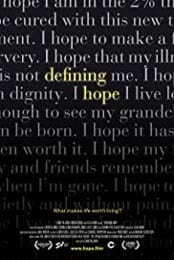
Defining Hope(2017)

GathrFilms
Release Date: Nov 3, 2017 | Limited

We aren't dying the way we used to. We have ventilators, dialysis machines, ICUs-technologies that can "fix" us and keep our bodies alive-which have radically changed how we make medical decisions. In our death-denying culture, no matter how sick we get, there is always "hope." D... Read all

Releases

Original Release | Nov 3, 2017

Defining Hope

Current Showtimes

orround
  • Sun Jul 19
  • Mon Jul 20
  • Tue Jul 21
  • Wed Jul 22
  • Thu Jul 23
  • Fri Jul 24
  • Sat Jul 25

    Other Details

    Country of Origin: United States

    Language: English

    Summaries

    Plot Summary

    • How do we want to die? It's a relevant question for every human being, yet it's one we avoid discussing, even when faced with a diagnosis of serious illness. The medical industry has progressed in wondrous ways -- new technologies arrive all the time, and innovative procedures and treatment options are constantly being rolled out. But the nurses who are closest to the patients will tell you: the more proficient we become at sustaining life, the more reluctant we are to confront and talk about death.Defining Hope, an hour-long documentary from director Carolyn Jones, asks essential questions about dying in America and starts a conversation that will, and must, continue after the credits roll. The film follows a group of patients who have received a life-threatening diagnoses and the nurses who guide them on their health care journeys. These brave patients and caregivers allow the viewer into their homes and hospital rooms as they open up in emotional interviews about what they hope for from life and how that hope evolves when life is threatened. The topic of "quality of life" is at the forefront, and with it, questions about "quality of death": when, where, with whom and with what degree of comfort. The project is threaded with optimism for new standards of candor about dying and how we can respect individuals' end-of-life wishes.The film opens at dawn in Diane Ryan's car as she commutes to Calvary Hospital in the Bronx, New York to work as a staff nurse. She describes the struggle of working at a place where "people come to die." As we follow on her rounds, we see Diane working with end-stage cancer patients and advanced Alzheimer's patients receiving hospice or palliative care. She says that her goal is to be an advocate for these patients and the family members who sit doting at their bedside. "If I can give these people just that one bit of dignity, I did my job," Diane says. In one patient story, we meet Barbara Stephenson, a preacher who is resolved to go home despite facing a dire cancer prognosis. Though with some difficulty, Diane and the Calvary team work to support and facilitate Barbara's wishes.We also witness Diane at home with her husband, two sons and the family pets, and we come to learn of Diane's own diagnosis of ovarian cancer. When she receives troubling news about her recovery, Diane's experiences as a nurse inform her perspective on how to balance debilitating chemotherapy with her overall well-being and peace of mind.Next we are introduced to Gilbert Oakley, a home hospice nurse. Gilbert visits the apartment of 95-year-old Berthold Cohen, who is in declining health. While Gilbert administers medications and reviews protocols, he also plays the difficult role of mediator between Bert and his wife, Charlotte. Charlotte struggles to reconcile Bert's wish to avoid hospitalization and die peacefully at home with her desire to make sure that he is safe, and with her own fears of losing her husband of seventy years.Another interviewee, Rudy Bilotti, a gregarious World War II veteran, takes a more philosophical approach. He is discharged from the hospital and rejects dialysis treatment for his kidney failure. "We're all afraid of dying, but it's a natural thing," Rudy says. "We cannot halt the inevitable."A chapter featuring Alena Sydnor provides a bracing view on questions of mortality for our younger generation. Alena, a 23-year-old aspiring journalist, suffers from brain tumors. Her doctors at the Children's National Medical Center in Washington, D.C., have asked Alena and her parents to consider a life-saving brain surgery that carries the risk of memory loss. Alena's cheery outlook is challenged by the consequential weighing of quality versus quantity of life.The film introduces additional patients and the nurses who care for them, but Diane Ryan's story is interwoven throughout. She takes on the role of protagonist, joining seemingly distinct stories that remind us that death is relevant to everyone - and maybe, thanks to a nurse's perspective, we can begin to talk about it more.

    Storyline

    • We aren't dying the way we used to. We have ventilators, dialysis machines, ICUs-technologies that can "fix" us and keep our bodies alive-which have radically changed how we make medical decisions. In our death-denying culture, no matter how sick we get, there is always "hope." Defining Hope tells the story of patients dealing with life-threatening illness as they move between ICUs, operating rooms, hospice care and home. Diane is a nurse caring for end-stage cancer patients when she is diagnosed with ovarian cancer herself. 23-year-old Alena undergoes a risky brain surgery that destroys her short-term memory. 95-year-old Berthold lives with his elderly wife who struggles to honor his wish of dying peacefully at home. Defining Hope follows these patients and others- and the nurses that guide them along the way- as they face death, embrace hope, and ultimately redefine what makes life worth living.

    Similar Movies

    Heaven in Stone and Glass

    1h 27m

    Documentary

    40 Years of Fuckin Up

    2h

    Biography, Documentary, Music

    Remake

    1h 54m

    Documentary

    Sherman’s March

    Other2h 37m

    Wildwood, NJ

    1h

    Documentary