
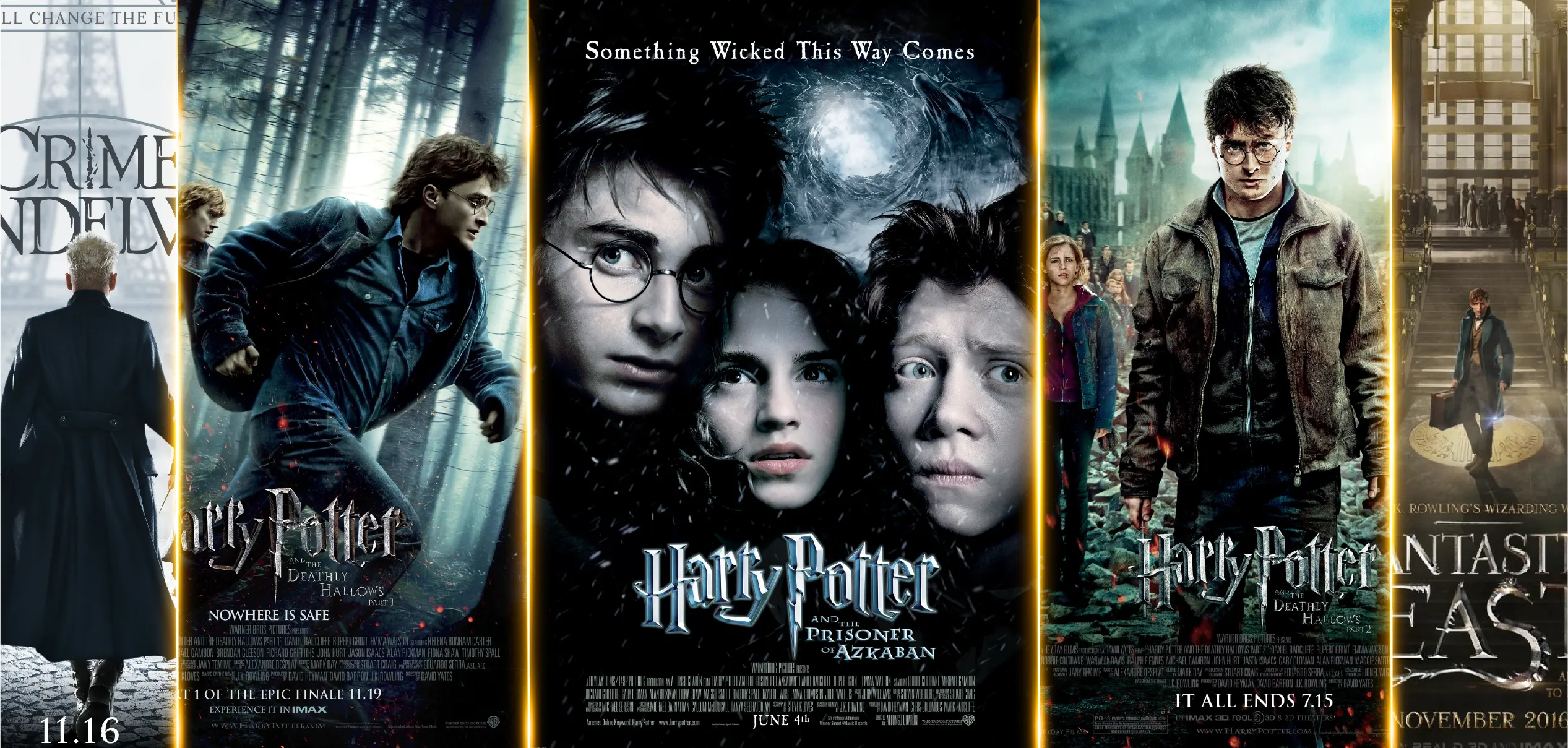

Twenty-five years after Chris Columbus’s Harry Potter and the Sorcerer’s Stone opened in November 2001, the Wizarding World film franchise is 11 movies deep: eight core Harry Potter adaptations from 2001 to 2011, plus three Fantastic Beasts prequels from 2016 to 2022.
The article below ranks all 11 using a five-mark framework- World-Building Fidelity, Character Anchor, Antagonist Threat, Cinematic Ambition, and Franchise Contribution- and tells you exactly where to watch each film right now. Alfonso Cuarón’s Harry Potter and the Prisoner of Azkaban (2004) is at #1. Fantastic Beasts: The Crimes of Grindelwald (2018) is at #11. The middle nine fit between them by specific mark counts, with every override to that count stated in the open.
The Five Marks framework is the ranking methodology and is explained in full before the list begins. After the ranked entries comes a streaming guide with every platform verified rather than assumed, a closer look at the Fantastic Beasts collapse, and a preview of HBO Max’s Harry Potter and the Philosopher’s Stone, which premieres on Christmas Day 2026 and is the reason to rank these films now rather than later. Two things make August 2026 the moment for this piece: all eight core Potter films return to cinemas worldwide from 27 August to 3 September to mark the 25th anniversary, and the first television adaptation of the books arrives four months later.
The Ranking at a Glance
| # | Film | Year | Director | Marks |
| 1 | Harry Potter and the Prisoner of Azkaban | 2004 | Alfonso Cuarón | 05-May |
| 2 | Harry Potter and the Deathly Hallows: Part 2 | 2011 | David Yates | 05-May |
| 3 | Harry Potter and the Half-Blood Prince | 2009 | David Yates | 05-May |
| 4 | Harry Potter and the Goblet of Fire | 2005 | Mike Newell | 05-May |
| 5 | Harry Potter and the Deathly Hallows: Part 1 | 2010 | David Yates | 05-May |
| 6 | Harry Potter and the Sorcerer’s Stone | 2001 | Chris Columbus | 03-May |
| 7 | Harry Potter and the Order of the Phoenix | 2007 | David Yates | 05-May |
| 8 | Harry Potter and the Chamber of Secrets | 2002 | Chris Columbus | 04-May |
| 9 | Fantastic Beasts and Where to Find Them | 2016 | David Yates | 04-May |
| 10 | Fantastic Beasts: The Secrets of Dumbledore | 2022 | David Yates | 02-May |
| 11 | Fantastic Beasts: The Crimes of Grindelwald | 2018 | David Yates | 01-May |
All 11 films are available to rent or buy on Amazon Video, Apple TV, and Fandango at Home in the US as of August 2026, and all 11 also stream on HBO Max and Peacock Premium.
Why Ranking the Wizarding World Series Matters in 2026
Fifteen years after Harry Potter and the Deathly Hallows: Part 2 concluded the original Harry Potter film series, Wizarding World cinema is entering its most significant new chapter. HBO Max’s Harry Potter and the Philosopher’s Stone television series premieres on Christmas Day 2026, the first live-action adaptation of the books since 2011 and the first attempt to render Rowling’s series at a scale the original films could not reach. That timing is the reason to rank the film franchise now.
Twenty-five years of Wizarding World cinema
The Harry Potter film franchise is one of the most sustained studio-cinema runs of the 21st century: 11 films across 21 years, from 2001 to 2022. Warner Bros. produced all 11. Four directors handled the eight core Potter movies: Chris Columbus, Alfonso Cuarón, Mike Newell, and David Yates, and Yates alone directed seven Wizarding World films, four Potters plus all three Fantastic Beasts. Across all 11 titles,s the franchise has taken more than $9.6 billion worldwide, of which the eight core Potter films account for roughly $7.7 billion. Ranking these films is not a low-stakes editorial exercise.
The Fantastic Beasts problem
The three Fantastic Beasts films represent one of studio cinema’s most visible collapses in reception quality. Fantastic Beasts and Where to Find Them (2016) was well received. Fantastic Beasts: The Crimes of Grindelwald (2018) is the worst-reviewed film in the franchise. Fantastic Beasts: The Secrets of Dumbledore (2022) recovered some ground and still finished as the lowest-grossing Wizarding World film ever released, at $407.2 million worldwide. A later section breaks down what specifically went wrong.
The HBO Max reset
The HBO Max television series is written and executive produced by Francesca Gardiner, with Mark Mylod directing multiple episodes and executive producing. Both came from Succession. Season one covers Harry Potter and the Philosopher’s Stone across eight episodes and premieres on 25 December 2026, earlier than the 2027 window HBO originally targeted. Dominic McLaughlin plays Harry, Arabella Stanton plays Hermione, Alastair Stout plays Ron, John Lithgow plays Dumbledore, Nick Frost plays Hagrid, Paapa Essiedu plays Snape, and Warwick Davis returns from the film era as Flitwick. Whether the series matches the films is the question the next decade answers. This ranking is the baseline it will be measured against.
The Five Marks of a Great Wizarding World Film
Every film in this ranking is scored against the same five marks, and the score is printed on every entry. The framework below names the criteria. A film that clears all five is a top-tier contender. A film that clears one is at the bottom. Everything else fits by mark count, and the three places where editorial judgment overrides the count are named openly in the final subsection.
Mark 1: World-Building Fidelity
Mark 1 measures whether the film inhabits the Wizarding World as a real place. Hogwarts as architecture rather than backdrop, Diagon Alley’s specific commerce, the Ministry of Magic’s bureaucracy, the accumulated detail Rowling built: every film is judged on how convincingly it renders all of it. Chris Columbus’s Harry Potter and the Sorcerer’s Stone (2001) sets the baseline. Alfonso Cuarón’s Harry Potter and the Prisoner of Azkaban (2004) deepens the aesthetic and gives the castle weather. David Yates carried the continuity through four Potters and three Fantastic Beasts. The television series inherits this foundation and has to reinvent it.
Mark 2: The Character Anchor
Mark 2 measures whether Harry, Ron and Hermione feel like people rather than plot vehicles, and in the prequels whether Newt Scamander can carry the same weight. Daniel Radcliffe, Emma Watson and Rupert Grint aged from eleven to twenty-one across the eight films, and their performances changed with them. The best Potter films are the ones where character work carries the plot instead of the reverse. The weakest prequels are the ones where Newt Scamander is not enough of an anchor for the ensemble crowding around him.
Mark 3: The Antagonist Threat
Mark 3 measures whether the villain is frightening and specific. Voldemort, played by Ralph Fiennes from Harry Potter and the Goblet of Fire onward and by Richard Bremmer briefly in Harry Potter and the Sorcerer’s Stone, is the overarching antagonist, but individual films substitute closer threats: Sirius Black as an apparent killer in Harry Potter and the Prisoner of Azkaban, Barty Crouch Jr. wearing Mad-Eye Moody’s face in Goblet of Fire, Dolores Umbridge in Harry Potter and the Order of the Phoenix, Bellatrix Lestrange across the later films. Films with a vivid antagonist clear Mark 3. Films where the villain stays distant do not.
Mark 4: The Cinematic Ambition
Mark 4 measures whether the direction pushes past franchise obligation. Alfonso Cuarón’s Harry Potter and the Prisoner of Azkaban is the clearest case, a film that treats the material as cinema rather than as a book on screen, and it introduced a visual language later directors kept borrowing. David Yates’s seven-film run has ambition with variable execution, and Harry Potter and the Half-Blood Prince is his most visually adventurous. Chris Columbus’s two films are careful rather than exploratory. The Fantastic Beasts films struggle here despite Yates’s continued involvement.
Mark 5: The Franchise Contribution
Mark 5 evaluates each film’s structural job in the saga. Harry Potter and the Sorcerer’s Stone built the world. Harry Potter and the Goblet of Fire returned Voldemort to a body. Harry Potter and the Half-Blood Prince set the finale up. Harry Potter and the Deathly Hallows: Part 2 paid it off. Every Potter film contributes something. The prequels are where Mark 5 becomes contentious: Fantastic Beasts and Where to Find Them adds Newt Scamander to the mythology, while The Crimes of Grindelwald and The Secrets of Dumbledore mostly add complications. Mark 5 is the fairest test of whether a film earns its place.
How the marks combine
Mark count sets the tier, and three named overrides adjust the order inside it. Films clearing all five marks occupy the top of the list. Films clearing four sit below them. Films clearing three or fewer sit lower again. The three overrides are stated rather than hidden: Harry Potter and the Sorcerer’s Stone is promoted above its 3/5 count because its Franchise Contribution is load-bearing for everything after it; Harry Potter and the Order of the Phoenix is demoted below its 5/5 count because compressing an 870-page book into 138 minutes costs it more than the scorecard registers; and Fantastic Beasts and Where to Find Them is demoted below its 4/5 count because the mark it fails, Antagonist Threat, is the one that broke the trilogy. Readers can audit all three.
Every Wizarding World Film Ranked, From #11 to #1
The ranking counts up from #11 to #1. Each entry carries the same details: a Five Marks scorecard, a defence of the placement, one Wizarding World moment worth remembering, and a Screendollars Take.
#11. Fantastic Beasts: The Crimes of Grindelwald (2018)
Marks: 1/5
Director: David Yates
Screenplay: J.K. Rowling
Runtime: 134 minutes
Where to watch: Rent or buy on Amazon Video, Apple TV and Fandango at Home. Also streaming on HBO Max and Peacock Premium.
The Five Marks scorecard
- World-Building Fidelity: Yes. The 1920s Wizarding World aesthetic is fully realised, and Paris is the best-looking thing in the film.
- Character Anchor: No. Newt Scamander is sidelined, and the film never settles on a protagonist.
- Antagonist Threat: No. Johnny Depp’s Grindelwald is undercut by the plot mechanics around him before anything off-screen is considered.
- Cinematic Ambition: No. The structure is convoluted rather than adventurous.
- Franchise Contribution: No. The retcons, the Credence parentage reveal chief among them, damage continuity the earlier films had established.
Why it’s ranked here. Fantastic Beasts: The Crimes of Grindelwald is the clean #11. It is the worst-reviewed film the Wizarding World has ever produced, and audiences turned on it as sharply as critics did, so the failure was not a critics-versus-fans argument. Rowling’s screenplay runs five plot threads at once: the Newt and Tina romance, the Queenie and Jacob rupture, Credence’s parentage, Nagini’s origin, and the Dumbledore and Grindelwald backstory, and develops none of them. That The Secrets of Dumbledore spent part of its own runtime unwinding the Credence reveal is the franchise conceding the point.
The Wizarding World moment that defines it. The Nurmengard rally, a scene built to make a villain magnetic that the film’s own machinery talks over.
The Screendollars Take: The Crimes of Grindelwald is not a bad film about Grindelwald. It is a film that forgot to be about anyone. Watch the rally sequence and count how many characters the camera has to check in on before the speech can land: by the time it returns to Grindelwald, the temperature has gone. Yates can stage this material, and the blue fire ringing the amphitheatre proves it. What he cannot do is give the scene a character to belong to. Five plots share a runtime that one plot needed.
#10. Fantastic Beasts: The Secrets of Dumbledore (2022)
Marks: 2/5
Director: David Yates
Screenplay: J.K. Rowling and Steve Kloves
Runtime: 142 minutes
Where to watch: Rent or buy on Amazon Video, Apple TV and Fandango at Home. Also streaming on HBO Max and Peacock Premium.
The Five Marks scorecard
- World-Building Fidelity: Yes. The Hogwarts scenes and the Bhutan sequences deliver.
- Character Anchor: No. Newt still lacks central weight, and Mads Mikkelsen’s Grindelwald is compelling but exists to serve plot.
- Antagonist Threat: Yes. Mikkelsen upgrades the threat considerably.
- Cinematic Ambition: No. The Bhutan election is visually strong; the film around it is not.
- Franchise Contribution: No. More complication, no better answer to why the prequel series exists.
Why it’s ranked here. Fantastic Beasts: The Secrets of Dumbledore is a recovery rather than a return. Mikkelsen replacing Depp is one of the more effective mid-franchise recastings in studio cinema, legibly menacing where the previous performance was performative, and bringing in Steve Kloves, who wrote seven of the eight Potter films, gave the script a spine it had been missing. Audiences noticed: they responded far more warmly than critics did, the widest such split in the franchise. None of it solved the underlying problem, and $407.2 million worldwide against a reported $200 million budget ended the arc.
The Wizarding World moment that defines it. The Bhutan election, with Mikkelsen’s Grindelwald addressing an assembled Wizarding World that has decided to listen to him.
The Screendollars Take: The Secrets of Dumbledore is not a course correction. It is a franchise apologising in public. The Bhutan sequence works because Mikkelsen plays Grindelwald as a politician rather than a wizard, lowering his voice when the crowd expects him to raise it. Kloves’s fingerprints show in the scenes that finally let two characters finish a conversation. The problem is what surrounds them: a film whose best argument for itself is that it is less confusing than the last one. Competence is not the same as necessity.
#9. Fantastic Beasts and Where to Find Them (2016)
Marks: 4/5
Director: David Yates
Screenplay: J.K. Rowling
Runtime: 133 minutes
Where to watch: Rent or buy on Amazon Video, Apple TV, and Fandango at Home. Also streaming on HBO Max and Peacock Premium.
The Five Marks scorecard
- World-Building Fidelity: Yes. 1926 New York is convincingly rendered as a magical city with its own laws and its own police.
- Character Anchor: Yes. Newt Scamander is a real protagonist, and Jacob Kowalski works as the audience’s way in.
- Antagonist Threat: No. The villain is Grindelwald wearing Percival Graves, and a late reveal cannot retroactively supply a threat the film spent two hours without.
- Cinematic Ambition: Yes. The period design and the creature work represent actual invention rather than franchise upkeep.
- Franchise Contribution: Yes. American wizarding history and Newt Scamander both enter the mythology here.
Why it’s ranked here. Fantastic Beasts and Where to Find Them is the strongest of the three prequels and the only one that reads as a legitimate expansion in hindsight. Eddie Redmayne’s Newt Scamander is nothing like Harry Potter, which is the point; Katherine Waterston and Alison Sudol open up a corner of the world the books never visited; Dan Fogler’s Kowalski is the warmest supporting turn in either era. It won Best Costume Design at the Academy Awards, still the only Oscar any Wizarding World film has won. It sits at #9 rather than #5 because the one mark it fails, Antagonist Threat, is precisely the failure the next two films inherited and could never repair.
The Wizarding World moment that defines it. The interior of the suitcase, with Newt walking Kowalski through habitats that should not fit inside a case that should not fit inside a film this crowded.
The Screendollars Take: Fantastic Beasts and Where to Find Them is not a prequel. It is a nature documentary that a conspiracy thriller keeps interrupting. The suitcase sequence is the film arguing for its own existence: Newt moves between climates, feeds things, apologises to them, and Redmayne plays the whole scene half-turned away from the camera like a man embarrassed to be watched being competent. Then the film remembers it has a shapeshifting villain to unmask. Everything the trilogy lost is already visible in that switch.
#8. Harry Potter and the Chamber of Secrets (2002)
Marks: 4/5
Director: Chris Columbus
Screenplay: Steve Kloves
Runtime: 161 minutes
Where to watch: Rent or buy on Amazon Video, Apple TV and Fandango at Home. Also streaming on HBO Max and Peacock Premium.
The Five Marks scorecard
- World-Building Fidelity: Yes. Second-year Hogwarts, the Burrow and the Chamber itself all land.
- Character Anchor: Yes. The trio keeps developing, and Kenneth Branagh’s Gilderoy Lockhart is the funniest performance in the series.
- Antagonist Threat: Yes. The Basilisk is frightening, and Tom Riddle’s diary delivers the first real Voldemort backstory.
- Cinematic Ambition: No. Columbus’s second film is polished and cautious, with no signature visual idea.
- Franchise Contribution: Yes. Tom Riddle arrives, and the Horcrux logic that pays off six films later is quietly seeded.
Why it’s ranked here. Harry Potter and the Chamber of Secrets is the least distinctive of the eight core films. At 161 minutes, it is the longest entry in the entire franchise, telling a story later films would have handled in two hours, and it plays notably safe next to what Cuarón did the following year. Every mark that matters clears. The film simply never reaches for anything. Branagh is the most-cited reason to revisit it, and he is playing a fraud in a film that is slightly too pleased with its own competence.
The Wizarding World moment that defines it. The Basilisk in the Chamber, the first time a Potter film stages real physical danger for an actual child and does not soften it.
The Screendollars Take: Chamber of Secrets is not the weakest Potter film. It is the one with the least to say. Columbus shoots the Basilisk sequence with genuine nerve, holding on Harry’s face in the flooded tunnel longer than a family film usually would, and it works. Then the film returns to being pleasant. Branagh understood the assignment better than the direction did: Lockhart is a man performing expertise he does not have, which is a sharper joke than anything else in the running time. Sixteen minutes shorter and it ranks higher.
#7. Harry Potter and the Order of the Phoenix (2007)
Marks: 5/5
Director: David Yates
Screenplay: Michael Goldenberg
Runtime: 138 minutes
Where to watch: Rent or buy on Amazon Video, Apple TV and Fandango at Home. Also streaming on HBO Max and Peacock Premium.
The Five Marks scorecard
- World-Building Fidelity: Yes. The Ministry of Magic is the most visually distinctive interior in the franchise.
- Character Anchor: Yes. Radcliffe plays Harry as actively unpleasant to be around, and Dumbledore’s Army gives the ensemble a spine.
- Antagonist Threat: Yes. Imelda Staunton’s Dolores Umbridge is the most effective villain in the series.
- Cinematic Ambition: Yes. Yates’s first Potter establishes the visual grammar he keeps for six more Wizarding World films.
- Franchise Contribution: Yes. The Department of Mysteries and Sirius Black’s death are structural pivots.
Why it’s ranked here. Harry Potter and the Order of the Phoenix is the most underrated Potter entry and also the clearest case of a film that scores better than it plays. Staunton’s Umbridge is institutional cruelty rather than personal malice, and the performance is why “Umbridge” now functions as shorthand well outside the books. The problem is arithmetic: 870 pages compressed into 138 minutes, the shortest film in the series adapting the longest novel. The D.A. subplot, Sirius Black’s screen time,e and several Order storylines all pay the price. This is the one demotion the framework applies downward, and it is applied here.
The Wizarding World moment that defines it. Umbridge as High Inquisitor, issuing educational decrees in a pink cardigan while the school quietly becomes a police state.
The Screendollars Take: Order of the Phoenix is not a film about Voldemort’s return. It is a film about a bureaucracy deciding that the truth is inconvenient. Staunton plays Umbridge without a single raised voice, which is why she is frightening: her cruelty is procedural, filed and countersigned. Yates shoots the Ministry as endless polished black, a place where nothing can be hidden and nothing can be proved. The film’s compression is real, and it costs it three places. The performance at the centre of it does not lose a thing.
#6. Harry Potter and the Sorcerer’s Stone (2001)
Marks: 3/5
Director: Chris Columbus
Screenplay: Steve Kloves
Runtime: 152 minutes
Where to watch: Rent or buy on Amazon Video, Apple TV and Fandango at Home. Also streaming on HBO Max and Peacock Premium. Returning to cinemas worldwide from 27 August 2026 with 12 minutes of behind-the-scenes footage not previously screened.
The Five Marks scorecard
- World-Building Fidelity: Yes. Columbus’s Hogwarts, Diagon All, ey and Quidditch are the template every later film works from.
- Character Anchor: Yes. The casting is exact, and the Radcliffe, Watson, and Grint chemistry is present from the first scene they share.
- Antagonist Threat: No. Voldemort riding on the back of Quirrell’s head is the weakest form the villain ever takes.
- Cinematic Ambition: No. The direction is reverent and careful rather than exploratory.
- Franchise Contribution: Yes. This is the film that made every other film on this list possible.
Why it’s ranked here. Harry Potter and the Sorcerer’s Stone is the promotion the framework applies upward, and the reason is stated plainly: on mark count it belongs at #9, but Franchise Contribution is not a mark like the others here. Columbus established Hogwarts as a place with a floor plan, and every subsequent director inherited it rather than invented around it. The film is 152 minutes of careful, unhurried world-building by a director who understood that the assignment was foundation rather than flourish. It grossed over $1.02 billion across its releases. Its weakness is exactly its virtue held too long.
The Wizarding World moment that defines it. The Great Hall on the first night, four tables and a ceiling full of weather, the scene every later fantasy franchise has tried to reproduce.
The Screendollars Take: Sorcerer’s Stone is not the best Potter film and was never trying to be. It is a set of foundations, poured slowly, by someone who knew what was going on top. Columbus shoots the first walk into the Great Hall as pure architecture: he holds wide, lets the candles do the work, and refuses to cut to reaction shots that would tell you how to feel. The Quirrell reveal is the weakest villain beat in the series. Twenty-five years later, nobody is describing Hogwarts to you. They are describing this.
#5. Harry Potter and the Deathly Hallows: Part 1 (2010)
Marks: 5/5
Director: David Yates
Screenplay: Steve Kloves
Runtime: 146 minutes
Where to watch: Rent or buy on Amazon Video, Apple TV and Fandango at Home. Also streaming on HBO Max and Peacock Premium.
The Five Marks scorecard
- World-Building Fidelity: Yes. The British landscape becomes Wizarding World material, which no earlier film had attempted.
- Character Anchor: Yes. The tent sequences are the best sustained character work in the franchise.
- Antagonist Threat: Yes. Voldemort is felt constantly, and the Snatchers make the danger ordinary and close.
- Cinematic Ambition: Yes. The atmospheric restraint is unusually confident for a franchise midpoint.
- Franchise Contribution: Yes. The Horcrux quest is set up properly so that Part 2 can run.
Why it’s ranked here. Harry Potter and the Deathly Hallows: Part 1 is the most atmospheric Potter film, and it draws the coolest critical notices of the core eight while audiences embrace it, the largest positive gap in the series. Yates directs with a patience the earlier films could not afford. The trio spends most of the running time cold, hungry, and losing faith in each other, and the film treats that as the story rather than as the gap before the story. Viewers who call it the camping film are describing the method accurately and mistaking it for a flaw. It sits at #5 because the mood-building is front-loaded and the payoff is in another film.
The Wizarding World moment that defines it. Harry and Hermione dancing in the tent to Nick Cave’s “O Children”, the only scene in eight films with no plot function at all.
The Screendollars Take: Deathly Hallows: Part 1 is not the prelude to the finale. It is the only Potter film about what losing feels like from the inside. The tent dance exists for no structural reason: nobody learns anything, nothing advances, and Yates lets it run anyway because the two of them need ninety seconds of not being doomed. Radcliffe plays it badly on purpose, all elbows. That is the film’s whole argument. Grief is boring and long, and it does not resolve because someone found a Horcrux.
#4. Harry Potter and the Goblet of Fire (2005)
Marks: 5/5
Director: Mike Newell
Screenplay: Steve Kloves
Runtime: 157 minutes
Where to watch: Rent or buy on Amazon Video, Apple TV and Fandango at Home. Also streaming on HBO Max and Peacock Premium.
The Five Marks scorecard
- World-Building Fidelity: Yes. The Triwizard Tournament, Beauxbatons and Durmstrang expand the world beyond Britain convincingly.
- Character Anchor: Yes. Harry at fourteen, dealing with a ball, a crush, and a death, is real adolescent territory.
- Antagonist Threat: Yes. Ralph Fiennes arrives, and the graveyard is the most cited scene in the franchise.
- Cinematic Ambition: Yes. Newell’s more adult register produced the first PG-13 film in the series.
- Franchise Contribution: Yes. Voldemort getting a body is the single biggest structural pivot in the saga.
Why it’s ranked here. Harry Potter and the Goblet of Fire is where the franchise grew up in public. Newell’s direction brought the Triwizard Tournament, the Yule Ball, and Cedric Diggory’s death into the same film and announced that this series would now be killing teenagers. It is the only core Potter film where critics rate it well above viewers, and the reason is pacing: 157 minutes for a 636-page book meant S.P.E.W. vanished, and much of the Barty Crouch Jr. groundwork went with it. The graveyard is worth the compression.
The Wizarding World moment that defines it. The graveyard, where Voldemort takes a body, Cedric Diggory dies pointlessly, and Harry escapes carrying a corpse.
The Screendollars Take: Goblet of Fire is not the film where the series got darker. It is the film where the series admitted that it had been a war story all along. Newell stages the graveyard without a score for its opening stretch, so the loudest sound is Wormtail breathing, and Cedric dies mid-sentence in the flat, unceremonious way people actually die. Fiennes plays Voldemort’s first minutes in a body as physical pleasure, flexing new fingers. Everything after this film is a consequence of these eight minutes.
#3. Harry Potter and the Half-Blood Prince (2009)
Marks: 5/5
Director: David Yates
Screenplay: Steve Kloves
Runtime: 153 minutes
Where to watch: Rent or buy on Amazon Video, Apple TV and Fandango at Home. Also streaming on HBO Max and Peacock Premium.
The Five Marks scorecard
- World-Building Fidelity: Yes. A Hogwarts under threat, a darkened Diagon Alley and the cave give the world real weather.
- Character Anchor: Yes. Sixth-year Harry, Ron and Hermione are at their most adult, and the Ron, Lavender and Hermione triangle is played straight.
- Antagonist Threat: Yes. Draco Malfoy as a reluctant Death Eater is the best character-driven antagonist in the series.
- Cinematic Ambition: Yes. Bruno Delbonnel’s cinematography is the strongest visual work in the franchise.
- Franchise Contribution: Yes. Horcruxes are explained, Dumbledore dies, and the endgame begins.
Why it’s ranked here. Harry Potter and the Half-Blood Prince is the most underrated top-tier Potter film. Delbonnel was nominated for Best Cinematography at the 82nd Academy Awards, the only cinematography nomination the series ever received, and the grey, desaturated palette he built is why this film looks like nothing else in the franchise. Tom Felton finally gets to play Draco as a frightened boy rather than a school bully. Alan Rickman does his most controlled work here. The complaints about narrative liberties, the burning of the Burrow chief among them, are fair and do not touch what the film achieves tonally.
The Wizarding World moment that defines it. The cave, with Dumbledore drinking the potion and begging while Harry keeps pouring, the most difficult scene in the series to watch.
The Screendollars Take: Half-Blood Prince is not a setup film. It is the one Potter film that looks like it was made by a cinematographer. Delbonnel drains the colour until Hogwarts reads as a photograph left in a window, and the cave sequence is lit almost entirely by one green glow off the water. Michael Gambon plays Dumbledore’s collapse as humiliation rather than heroism, an old man asking a child to stop. Felton spends the film not doing the thing he has been sent to do. That is the most adult idea in the franchise.
#2. Harry Potter and the Deathly Hallows: Part 2 (2011)
Marks: 5/5
Director: David Yates
Screenplay: Steve Kloves
Runtime: 130 minutes
Where to watch: Rent or buy on Amazon Video, Apple TV, and Fandango at Home. Also streaming on HBO Max and Peacock Premium.
The Five Marks scorecard
- World-Building Fidelity: Yes. Hogwarts as a war zone, Gringotts, and the castle raising its own defences.
- Character Anchor: Yes. A decade of performance resolves, and Snape’s memories deliver the biggest character reveal in the series.
- Antagonist Threat: Yes. Voldemort finally becomes the physical antagonist he has been building toward, and Bellatrix peaks alongside him.
- Cinematic Ambition: Yes. The Battle of Hogwarts is among the better large-scale battle sequences in franchise cinema, and “The Prince’s Tale” is the best-directed passage in the series.
- Franchise Contribution: Yes. Ten years of setup, paid.
Why it’s ranked here. Harry Potter and the Deathly Hallows: Part 2 is the best-reviewed film in the franchise with critics and audiences alike, and at 130 minutes it is also the shortest of the eight. Yates’s final Potter earns the ending. The Battle of Hogwarts is staged with real geography, so you always know which courtyard is falling, and “The Prince’s Tale” recontextualises a decade of a character’s behaviour in roughly seven minutes without a word of explanation from anyone still alive. It sits at #2 only because Prisoner of Azkaban accomplishes more per minute. Placing this film first is a defensible position.
The Wizarding World moment that defines it. “The Prince’s Tale”, the Pensieve sequence that turns Snape from antagonist into the saga’s most sustained act of love.
The Screendollars Take: Deathly Hallows: Part 2 is not a battle film with a twist at the end. It is a two-hour delaying action before seven minutes of Alan Rickman. Yates shoots “The Prince’s Tale” almost silently, in fragments, refusing to underline a single revelation, and Rickman plays a man who has been performing contempt so long that tenderness arrives as a physical injury. The battle around it is well made, and you will forget it. Nobody forgets him kneeling in the rubble of a house he could not save.
#1. Harry Potter and the Prisoner of Azkaban (2004)
Marks: 5/5
Director: Alfonso Cuarón
Screenplay: Steve Kloves
Runtime: 142 minutes
Where to watch: Rent or buy on Amazon Video, Apple TV and Fandango at Home. Also streaming on HBO Max and Peacock Premium.
The Five Marks scorecard
- World-Building Fidelity: Yes. Cuarón gives Hogwarts seasons, a working clock and a Whomping Willow that shakes off snow.
- Character Anchor: Yes. Thirteen-year-old Harry, Ron and Hermione are at their most naturalistic, in untucked shirts and their own clothes.
- Antagonist Threat: Yes. Sirius Black is the apparent threat; the Dementors are the actual ones, and they never stop being frightening.
- Cinematic Ambition: Yes. The time-turner passage is one of the most elegant structural moves in studio filmmaking.
- Franchise Contribution: Yes. The Marauders, Peter Pettigrew, and the tonal register the later films run on all start here.
Why it’s ranked here. Harry Potter and the Prisoner of Azkaban is the artistic peak of the franchise, and it is the peak by a margin that critical consensus has only widened over twenty years. Cuarón arrived from Y Tu Mamá También (2001) and left for Children of Men (2006), and he treated the assignment as cinema rather than as transcription. The Dementors are the most effective non-human threat in the series. Michael Gambon takes over as Dumbledore after Richard Harris’s death and immediately plays him as stranger and less benign. Cuarón made one Harry Potter film. It is the one everyone else has been compared against since.
The Wizarding World moment that defines it. The time-turner sequence, ninety minutes of film replayed from a new angle, with every apparent coincidence revealed as something the characters did themselves.
The Screendollars Take: Prisoner of Azkaban is not the best Harry Potter film. It is the only one that would still be a good film if you removed the wizards. Cuarón shoots the time-turner passage as a second viewing of a first viewing, and it works because he planted every payoff in plain sight the first time through, trusting an audience of children to have been paying attention. The Dementors are frightening because they do nothing: they arrive, and joy leaves the frame. He was offered the sequels and did not take them. This is what one pass by an auteur looks like.
Where to Watch Every Harry Potter Film Right Now: Complete Streaming Guide
All 11 Wizarding World films stream on both HBO Max and Peacock Premium in the US, verified via JustWatch in August 2026. The films have moved between those two services repeatedly since 2020, so a guide that names only one of them is wrong roughly half the time. The section below sets out both subscription routes, the rental and purchase options, and the watch orders worth using.
Subscription streaming: HBO Max and Peacock
US, all 11 films: Streaming on HBO Max and Peacock Premium, and on HBO Max via Amazon Channels and Peacock Premium Plus. Several titles also stream on YouTube TV.
HBO Max is Warner Bros. Discovery’s own service and carries the surrounding material as well: the Harry Potter 20th Anniversary: Return to Hogwarts reunion special from 2022, franchise documentaries, and from Christmas Day 2026 the new television series. Peacock’s rights come from a long-running NBCUniversal distribution deal covering the Wizarding World. The practical consequence for readers is that if you already subscribe to either service, you do not need to rent anything.
Rental and purchase
US, all 11 films: Rent or buy on Amazon Video, Apple TV and Fandango at Home. Rental is also available through Spectrum On Demand. Physical 4K UHD Blu-ray collections remain widely stocked.
We are not publishing rental prices. They move by title, by retailer and by promotional window, and a price printed in an article is wrong within weeks. Check the retailer directly. What matters more is the point above: both major subscription routes currently carry all 11 films, so paying to rent one is almost certainly unnecessary.
In cinemas: the 25th anniversary run
All eight core Harry Potter films return to cinemas worldwide from 27 August to 3 September 2026, timed to the Back to Hogwarts celebration and the 25th anniversary of the first film. Harry Potter and the Sorcerer’s Stone screens with 12 minutes of behind-the-scenes footage not previously shown on the big screen. In the US, participating chains include AMC, Regal, Cinemark, Harkins, Megaplex and Marcus, with tickets through Fandango. Regal’s Back to Hogwarts programme runs one film per day from 25 August. Cosm venues in Los Angeles, Dallas and Atlanta are screening the first film in their large-format Shared Reality presentation, with Detroit following in September.
The recommended watch order for first-timers
Watch the eight core Potter films in release order:
- Sorcerer’s Stone (2001)
- Chamber of Secrets (2002)
- Prisoner of Azkaban (2004)
- Goblet of Fire (2005)
- Order of the Phoenix (2007)
- Half-Blood Prince (2009)
- Deathly Hallows: Part 1 (2010)
- Deathly Hallows: Part 2 (2011)
Release order and in-universe chronology are the same thing here, so there is nothing to reconcile. Total running time is 1,179 minutes, or 19 hours and 39 minutes. First-time viewers can skip the Fantastic Beasts films without losing anything.
The completionist order
For every film: the eight Potters in release order, then the three Fantastic Beasts films in release order:
- Fantastic Beasts and Where to Find Them (2016)
- The Crimes of Grindelwald (2018)
- The Secrets of Dumbledore (2022)
Total running time across all 11 is 1,588 minutes, or 26 hours and 28 minutes. The alternative is in-universe chronology, prequels first, and it requires accepting continuity that the prequels themselves revised between instalments.
Preparing for the television series
Viewers getting ready for HBO Max’s Harry Potter and the Philosopher’s Stone on 25 December 2026 need to rewatch exactly one film: Harry Potter and the Sorcerer’s Stone, at 152 minutes. That is the adaptation the series will be compared against first, and it is ranked #6 here. A full eleven-film rewatch before Christmas is more likely to colour your reception of the series than sharpen it.
International availability
Streaming rights vary substantially by market, and this guide verifies the US only. In the UK, Ireland and elsewhere the films have moved between Sky, Now, Netflix and HBO Max at different points, and any single answer goes stale quickly. Check JustWatch for your own region before subscribing to anything. Rental and purchase are available in virtually every market.
The Fantastic Beasts Complications: Where the Prequel Series Failed
The three Fantastic Beasts films fell from well-reviewed to the worst-reviewed in the franchise and recovered only partway, while worldwide grosses fell from $814 million to $654.9 million to $407.2 million. That is not a gentle decline. It is a franchise losing critics first and audiences immediately after. The section below sets out what went wrong.
The original problem: Newt Scamander was never a protagonist
Rowling’s 2001 companion book Fantastic Beasts and Where to Find Them was a mock Hogwarts textbook cataloguing magical creatures, and Newt Scamander existed in it only as the fictional author’s name on the cover. The 2016 screenplay gave him a story: 1926 New York, escaped creatures, a Magical Congress conspiracy, but it also gave him a temperament: a naturalist who observes, avoids eye contact, and prefers animals to people. Redmayne plays that exactly as designed. The design cannot carry a five-film arc, which is what Warner Bros. had planned.
The Grindelwald reveal problem.
The 2016 film’s third-act reveal that Colin Farrell’s Percival Graves had been Grindelwald all along created a structural problem the sequels never solved. Recasting the role to Johnny Depp for 2018 was a studio hedge that produced its own difficulties. Recasting again to Mads Mikkelsen for 2022 was corrective but could not unwind the plot mechanics The Crimes of Grindelwald had already laid down. Three films, three Grindelwalds. Antagonist inconsistency at that rate would damage any franchise, and this one had built its entire remaining arc on the character.
The screenwriting critique
Rowling wrote all three Fantastic Beasts screenplays, with Steve Kloves joining as co-writer on the third. The consistent critical argument was that Rowling as screenwriter worked at a different level from Rowling as novelist, and The Crimes of Grindelwald is the case in point: five plot threads, no through line, and a series of reveals that ask the audience to care about relationships the film has not established. Kloves had adapted seven of the eight Potter films. Bringing him in for the third Beasts film improved the structure measurably and arrived two films late.
The public controversy problem
Between 2020 and 2022, two separate controversies attached themselves to the franchise: Rowling’s public statements on transgender issues, which generated sustained and continuing objection, and Johnny Depp’s high-profile legal proceedings involving his former wife. Both affected how Warner Bros. could market the films. The Secrets of Dumbledore was promoted with visibly less volume than a Wizarding World tentpole would normally receive, which is a commercial judgment about brand difficulty rather than a comment on either dispute.
Why the arc ended
Fantastic Beasts: The Secrets of Dumbledore took $407.2 million worldwide against a reported $200 million budget, less than half the first film’s $814 million and the lowest total any Wizarding World film has recorded. Warner Bros. never announced a cancellation of the planned fourth and fifth films, and as of August 2026 neither has been announced as in production either. The 2023 announcement of the HBO television series reads, in hindsight, as the studio changing strategy entirely: a decade-long adaptation of the books people already love rather than further expansion into material they did not ask for.
What the collapse says about franchise cinema
The Fantastic Beasts arc is a usable case study, and its lessons are specific rather than general. A supporting character does not automatically support five films. A novelist’s instincts do not automatically transfer to screenplay structure. Recasting a central antagonist twice inside three films is close to unrecoverable. And audiences reward expansions that add to a property they love while punishing expansions that complicate or contradict it. Every Wizarding World project now in development, the television series included, is being planned with those four lessons visible.
The HBO Max Series: What to Expect from Harry Potter and the Philosopher’s Stone
HBO Max’s Harry Potter and the Philosopher’s Stone premieres on 25 December 2026, the first live-action Wizarding World adaptation since Deathly Hallows: Part 2 in 2011 and the first attempt to render the books at television length. The section below covers what the series is, who is making it, and how it will be measured against the film ranked #6 in this article.
The basics
Season one carries the title Harry Potter and the Philosopher’s Stone, runs eight episodes, and adapts the first book. Francesca Gardiner writes and executive produces; Mark Mylod directs multiple episodes and executive produces. Both worked on Succession. J.K. Rowling executive produces alongside Neil Blair and Ruth Kenley-Letts of Brontë Film and TV and David Heyman of Heyday Films. HBO renewed the series for a second season before the first had aired, with season two expected to adapt Harry Potter and the Chamber of Secrets and filming from autumn 2026. The stated plan is one season per book. No release date for season two has been announced as of August 2026.
The cast
Dominic McLaughlin plays Harry Potter, Arabella Stanton plays Hermione Granger, and Alastair Stout plays Ron Weasley, all three cast from an open call that drew more than 30,000 auditions. The Hogwarts faculty is John Lithgow as Albus Dumbledore, Janet McTeer as Minerva McGonagall, Paapa Essiedu as Severus Snape, Nick Frost as Rubeus Hagrid, Luke Thallon as Quirinus Quirrell, and Paul Whitehouse as Argus Filch. Warwick Davis returns as Filius Flitwick, the only performer carrying over from the films. Lox Pratt plays Draco Malfoy, Johnny Flynn plays Lucius Malfoy, Katherine Parkinson plays Molly Weasley, Bel Powley and Daniel Rigby play Petunia and Vernon Dursley, Anton Lesser plays Garrick Ollivander, Louise Brealey plays Madam Hooch and Bertie Carvel plays Cornelius Fudge.
What is different from the 2001 film
Four differences matter. Eight episodes give the first book several times the 152 minutes Columbus had, which permits fidelity the film could not afford. A Succession creative team suggests a register closer to prestige drama than to family fantasy. Twenty-five years of production advances will visibly update the world’s look, and the show will have to decide how much of Stuart Craig’s original design language to keep. And the ensemble is more racially diverse than the film cast, with Paapa Essiedu’s Snape the most substantial reimagining of a role audiences hold strong pictures of.
What could go right, and what could go wrong
The upside is simple: this creative team applied to this material for a decade could produce the most complete adaptation the books have had, with room for the subplots every film compressed. The casting process was unusually careful. The downside is equally clear. Twenty-five years of attachment to the films means every casting choice, every cut and every design decision invites a comparison the series did not ask for, and some of those comparisons will damage it regardless of quality. Rowling’s continued role as executive producer also keeps the surrounding controversy attached to the project.
What this ranking means for the comparison
Every film here becomes part of the argument about how the series measures up, but one film carries it. Harry Potter and the Sorcerer’s Stone at #6 is the specific adaptation the December 2026 premiere gets compared against, and its scorecard says exactly where the opening is: it fails Cinematic Ambition and Antagonist Threat. A television team with eight episodes and a prestige-drama register has the most obvious room to improve on precisely those two marks. Whether it does is the question the next decade answers. For a wider view of how this era’s screen performances rank against each other, see our list of the greatest movie performances of the 21st century.
Alternative Viewing Orders, for Rewatchers and Newcomers
Not every viewer wants the 11 Wizarding World films in release order. Below are four alternative plans: in-universe chronology, the pared-down core eight, a quality-first order for rewatchers, and the short preparation for the television series.
The chronological in-universe order
Events in the order they happen inside the fiction. Start with the prequels: Fantastic Beasts and Where to Find Them (1926 setting), The Crimes of Grindelwald (1927), The Secrets of Dumbledore (1932). Then the eight core Potters, set between 1991 and 1998, in release order.
Total running time is 26 hours and 28 minutes. This order asks you to accept continuity of the prequels revised as they went, particularly around Dumbledore’s history and the Credence storyline, and it front-loads the three weakest films in the franchise. Rewatchers only.
The core eight
For the essential experience without the prequels: the eight Potter films in release order, 19 hours and 39 minutes. This is our recommended default. Every book is adapted, nothing load-bearing is missed, and the films get better as they go, which is the correct shape for a first watch. Anyone starting the franchise should start here and decide about Fantastic Beasts afterwards.
The quality-first order
For rewatchers who want the strongest films first, follow this ranking from the top: Prisoner of Azkaban, Deathly Hallows: Part 2, Half-Blood Prince, Goblet of Fire, Deathly Hallows: Part 1, Sorcerer’s Stone, Order of the Phoenix, Chamber of Secrets. It is a different experience, since you begin at the artistic peak and work down through the strong middle rather than climbing toward a finale. It also spoils the ending in the second film. Never do this to a first-time viewer.
The pre-series preparation
For readers getting ready for the HBO Max series on 25 December 2026: watch Harry Potter and the Sorcerer’s Stone, 152 minutes, and stop. That single film is the reference point the new adaptation will be measured against, and it is a small enough commitment that it sharpens the comparison rather than saturating it.
Character-focused rewatches
Draco Malfoy’s arc runs through Half-Blood Prince, where he carries a plot for the first time, and both Deathly Hallows films. Snape’s runs through Prisoner of Azkaban, Half-Blood Prince, and both Deathly Hallows films, and it only resolves in the last twenty minutes of the last one. Hermione’s best material is in Prisoner of Azkaban for the time-turner, Order of the Phoenix for Dumbledore’s Army, and Deathly Hallows: Part 1 for Godric’s Hollow and the tent.
The Baseline the Television Series Inherits
Twenty-five years on from that first release in November 2001, the Wizarding World on screen adds up to eleven films across two eras, and the shape of it is finally clear. Prisoner of Azkaban is the peak the franchise hit early and never quite matched, the core eight mostly still hold up on a rewatch, and the three Fantastic Beasts films are the cautionary tale about how fast a beloved property can lose its way. That is the baseline the television series inherits.
When HBO Max’s Philosopher’s Stone arrives on Christmas Day 2026, it gets measured against all of it, and against the film it remakes most of all, the 2001 original ranked #6 here. Eight episodes give it room the movies never had and nowhere to hide. Until it proves otherwise, these films are the whole of the Wizarding World on screen, and Prisoner of Azkaban is still the one to beat.